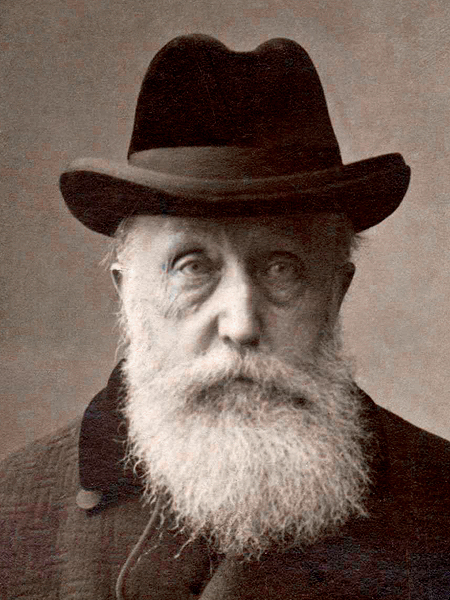
 M.Yourcenar wrote that his father and his two (sic!) brothers were killed by farmers driven on by a red instigator. (p.319)
A certain parallel to these fictional events may seem to exist inasmuch as Arnold Julius von Vietinghoff, Conrad’s father, the painter’s grand-father, was almost killed by a ringleader during the Revolution of 1905/1906. Although he was of the age 72, he was able to defend himself with all his strength, just using a fire tongs from the fireplace. This possibly was told to the writer M.Y. by the painter at the occasion of their encounter in 1983 or 1986.
However, it is a blatant contradiction to Yourcenar's narrative that the grand-father was always bed-ridden and went out leaned on his crutches (p.326). The Salisburg manor house was plundered and burned but after this, Arnold Julius lived another 13 years seasonally in Riga and Riga's Beach in Bilderlingshof (in Latvian Bulduri, today part of Jurmala). During his last lifetime, his second son Oscar, the last owner of Salisburg (Conrad’s brother) lived with him or nearby in Livonia. After the death of Arnold Julius in 1918 and the Revolution of 1918, Oscar, his wife and their two children lived in Berlin.
 Therefore, the anecdote on the dirty monk, now covered with gold (p.158, means Rasputin) has nothing to do with the Vietinghoffs, as well as the detailed descriptions of the ballet performances (p.159-161) and the androgynous erotic gathering (p.162). M.Y. does not miss a chance to embellish her stories with her own fantasies.
 Definitely, the couple Jeanne and Conrad visited Conrad's parents at Salisburg three times: in 1901 for their engagement and then twice, each time when their sons were one year old (1904 and 1905). Before the occasion of the division of his father's estate in 1904, Conrad may have travelled alone to the estate in 1903.
To reach Salisburg it was necessary to make a stopover in Riga whereas Saint Petersburg was much farther away. The Vietinghoff family was distributed in all four Baltic provinces, also in Courland. However, Conrad's parent’s home was situated in neighboring Livonia. He was not absorbed in his career as a musician, since he did not have any career.
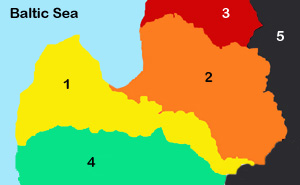
[The Baltic region during the 19th century till 1918: 1 Courland, 2+3 Livonia, 4 Lithuania, 5 Russia --- Later 1+2 Latvia, 3 Estonia]
 The young Baltic aristocrat character named "Egon von Reval" should represent the historic Conrad von Vietinghoff, the painter"s father. The author M.Y. created a literary figure from a few factual elements she knew. The reader follows the story with excitement but it has almost nothing to do with the real Conrad whom the author had acquaintance with. She has skillfully interwoven her historical knowledge, insights into social customs and connections, clever observations and psychological nuances with her rich imagination and projections.
 Conrad v.V. had three, not six brothers or seven, and was not educated in the Prussian style since the Germans in the Baltic regions followed their own more lifestyle. The author used the cliché that all Germans should click their heels, more or less audibly (p.100). This is contrary to the character of a Baltic baron.
Conrad did not study in Riga, Vienna, Paris and Zurich but did in Dorpat, Leipzig, Berlin, and for a short time in Rome. (p.100, 109) Therefore it is unlikely, that he received a piano diploma in Riga.
As written (p.100), it is true that until the Russian Revolutions (1905 and 1918), his family was rich in forestland and fields. In the 19th century, Conrad's grandfather possessed some amazing 64,000 acres before Conrad's father donated a certain percentage of it to landless farmers. After the division of his wealth to his sons, Conrad was not poor having received his inheritance in cash. Also it was not the conceit of his family which forbid him to give paid concerts. Rather, it was shyness and fear of big and anonymous audiences that prevented him from giving public performances. M.Y. also claimed that he overcame his nervous fear of public entrance (p.310). This is also not correct.
As written (p.100), it is true that until the Russian Revolutions (1905 and 1918), his family was rich in forestland and fields. In the 19th century, Conrad's grandfather possessed some amazing 64,000 acres before Conrad's father donated a certain percentage of it to landless farmers. After the division of his wealth to his sons, Conrad was not poor having received his inheritance in cash. Also it was not the conceit of his family which forbid him to give paid concerts. Rather, it was shyness and fear of big and anonymous audiences that prevented him from giving public performances. M.Y. also claimed that he overcame his nervous fear of public entrance (p.310). This is also not correct.
 5) In contrast to two of his relatives, he never joined any armed action against the Bolsheviks in his homeland during the Russian Civil War. During World War I, he lived with his wife and children in Switzerland, first in Geneva (since 1913), then in Zurich (since 1917).
 6) He was a piano player not a composer; he never wrote any composition.
7) Though he occasionally conducted some private lessons with a few people around him, he was not a professional music teacher.
8) He was open to contemporary music and loved to play works of the Post-Romantic composers Alexander Skrjabin, Sergei Rachmaninoff, Richard Strauss, and especially Max Reger. Yet, he was never a fan of the avant-garde and never a proponent of the twelve-tone music (atonality).
9) There was no scandal in Rome as was mentioned or invented by Marguerite Yourcenar. If there was any scandal, Conrad had nothing to do with it.
Conrad did not enjoy public recognition and performed publicly (i.e. outside of his home) at only two charity concerts at Neuwied Castle (Germany) in 1910 and in Fribourg (Switzerland) in 1923.
10) Other characterizations of the fictional character "Egon von Reval" do not describe Conrad von Vietinghoff (p.104). It is neither imaginable that he took the fiddle of the village's violinist to play at a lively dance (there was never any hint from the family that he could play a violin) nor is it imaginable that he wrestled with a ram by grabbing it by the horns. To romp around with the farmer's children and those of the inhabitants of the forest on his parent's estate, then all together drive home the livestock, and finally to shed his clothes for a bath in the pond – all this would only be possible in his childhood. (p.108) Neither his status nor his individual character would have allowed him to do so as an adult.
The fictitious figure is exhilarated by wild diversions such as horseback riding or expeditions through the woods. (p.174) It is unknown whether the factual Conrad was an experienced equestrian rider, although in his youth he made some occasional rides on the parent's property together with his brothers as part of their education. However, such youthful excursions occurred before 1890 when he still lived in Livonia. It is doubtful that he would have ridden on the occasion of his visits in 1902, 1904 or 1905 when he was first visiting his parents with Jeanne and then later together with their children.
The fictitious figure is exhilarated by wild diversions such as horseback riding or expeditions through the woods. (p.174) It is unknown whether the factual Conrad was an experienced equestrian rider, although in his youth he made some occasional rides on the parent's property together with his brothers as part of their education. However, such youthful excursions occurred before 1890 when he still lived in Livonia. It is doubtful that he would have ridden on the occasion of his visits in 1902, 1904 or 1905 when he was first visiting his parents with Jeanne and then later together with their children.
11. Indeed, Conrad and Jeanne occupied an upper floor of a new house built in 1898 at Rue Cernuschi in Paris. Perhaps their son, the painter, told M.Y. this when they met during 1983 in Amsterdam or 1989 in Zurich. In the novel Yourcenar's father appears in this flat after the death of his wife Fernande. According to the historic chronology this could not have happened before fall 1904. The alleged letter from 1904, in which the second son of Jeanne (Alexis, born in September 1904) is mentioned, does not allow for an earlier encounter. In addition, Yourcenar wrote about Jeanne on the occasion of Michel's visit: Five years and two children did not change her (p.123). At that time, the couple lived there at least two and a half years, therefore the apartment certainly was not almost empty with open shipping crates from Russia with straw falling out of them. In the following chapter, M.Y. wrote: And again I see myself confused by the problem of the dates of my childhood, alone in a large and empty landscape where everything seems sometimes near and sometimes faraway. … Since my early childhood, my sense of time always gave me a feeling of weakness: currently it is the same as it always has been. … All this is floating between my third and sixth year [1905-1908] (p.152)
12) He did not pursue a career because of artistic failures but due to his highly sensitive nature which prevented him from performing on stage in the presence of a large anonymous public. Besides some private concerts at home for a certain circle of friends, especially during his years in Wiesbaden, he played only for himself and a few of his closest friends. For magnificent solo performances, he was much too shy and introverted.
There was no financial inequality between Jeanne and Conrad, the parents of Egon von Vietinghoff.
Conrad and Jeanne may not have really lived together for some months or even for one or two years. Yet, there was neither a known separation nor proof of a farewell letter. Jeanne spent the last days of her life in a specialized sanatorium on Lake Geneva, whereas Conrad remained in their house in Zurich as he could not help her.
There was no financial inequality between Jeanne and Conrad, the parents of Egon von Vietinghoff.
Conrad and Jeanne may not have really lived together for some months or even for one or two years. Yet, there was neither a known separation nor proof of a farewell letter. Jeanne spent the last days of her life in a specialized sanatorium on Lake Geneva, whereas Conrad remained in their house in Zurich as he could not help her.
14.(p.128) M.Y. wrote somewhat laconically: Jeanne simply gave herself to him. Michel experienced this gift with great gratitude and a little surprise. He could not imagine that a virtue which he supposed to be a moral law for her would collapse so fast. Considering all the demonstratively fictitious scenes, the question arises for why this specific story should correspond with historical facts.
Anyway, the author sketches Jeanne in the figure of "Plotina" in her novel Hadrian’s Memoirs as completely different (p.83): … nor had she my passionate desire for the human body. She was chaste by reason of her disgust with the merely facile…. Then in the figure of Valentina in her novel "Anna, soror …": (Oeuvres romanesques, p.854) As exemplary of a good spouse she has never had a lover….
15. (p.136-144) The violent dialogue between Michel de Crayencour and "Egon von Reval" in Scheveningen seems to be created by the author's taste for drama rather than by any real event, similar to the story with the ram or the visit to the Baltic region in WW I. We see the same dramatized direction in the novel when during a fit of rage with Jeanne "Egon von Reval" says: Over all these years there was never a day, never a moment when you did not instill in me a sense of abhorrence.. Said during travels in Italy which is fiction from beginning to end anyway, including the above mentioned scandal. Most probably, this scandal in Rome goes back to Yourcenar's own experiences with Daniel, the boyfriend of her companion Jerry Wilson in India (see the biography from Michèle Goslar, p. 320).
16. (p.156) It is uncertain whether Jeanne and Conrad's encounter with the tsar and the tsarina really happened. The tsar did not visit the Salisburg manor but there would be other occasions to have met him. The encounter in the novel may be concocted just as likely from two other events: a) the visit of the Saxon king at Neschwitz castle, the property of Conrad’s eldest brother, and b) the painter's anecdote when Conrad, Jeanne and their children were invited to a banquet in Wiesbaden by the German emperor Wilhelm II. Perhaps M.Y. perhaps learned both stories from the painter.
Anyway, the author sketches Jeanne in the figure of "Plotina" in her novel Hadrian’s Memoirs as completely different (p.83): … nor had she my passionate desire for the human body. She was chaste by reason of her disgust with the merely facile…. Then in the figure of Valentina in her novel "Anna, soror …": (Oeuvres romanesques, p.854) As exemplary of a good spouse she has never had a lover….
15. (p.136-144) The violent dialogue between Michel de Crayencour and "Egon von Reval" in Scheveningen seems to be created by the author's taste for drama rather than by any real event, similar to the story with the ram or the visit to the Baltic region in WW I. We see the same dramatized direction in the novel when during a fit of rage with Jeanne "Egon von Reval" says: Over all these years there was never a day, never a moment when you did not instill in me a sense of abhorrence.. Said during travels in Italy which is fiction from beginning to end anyway, including the above mentioned scandal. Most probably, this scandal in Rome goes back to Yourcenar's own experiences with Daniel, the boyfriend of her companion Jerry Wilson in India (see the biography from Michèle Goslar, p. 320).
16. (p.156) It is uncertain whether Jeanne and Conrad's encounter with the tsar and the tsarina really happened. The tsar did not visit the Salisburg manor but there would be other occasions to have met him. The encounter in the novel may be concocted just as likely from two other events: a) the visit of the Saxon king at Neschwitz castle, the property of Conrad’s eldest brother, and b) the painter's anecdote when Conrad, Jeanne and their children were invited to a banquet in Wiesbaden by the German emperor Wilhelm II. Perhaps M.Y. perhaps learned both stories from the painter.
It is impossible to prove the opposite but it fits to Marguerite Yourcenar's narrative style that in all her novels she skillfully merged truth and fiction. Is Michel, her father, really the author of the quoted poem dedicated to Jeanne or is it written by herself? Remember Jeanne's fiction letter to Michel (see paragraph 3). Even if he was the writer – the realm of poems is a particular field full of longings and imagination, an oasis of unfulfilled desires in the desert of realities and banalities. Thus it is incomprehensible to consider the following lines taken from a three verse poem (in our literal translation) as fulfilled love.
I would like to lie at your feet in oblivion of the things,
Looking at your face while waiting my death,
And when He is coming, lean over my bed,
Thus, at the great waking-up I am favored with the fortune,
To feel your kiss very lively on my lips,
Keeping its sweetness throughout eternity.
Yourcenar suggests The quasi marital intimacy of the last verse and an especially the experienced continuing sweetness of the kiss would let me believe that Michel enjoyed in this world, a happiness which he claimed for eternity. Is it possible that Yourcenar's innermost desire was so strong that she wanted to have the most important persons in her life united – despite her prudent and brilliant qualities as a writer? She may have repeatedly imagined the unification of the two formative personalities in her life, the real father Michel and her "dreamed mother" Jeanne. Could this be the reason why she is over-interpreting the last lines? Based on a neutral analysis, the famous author's interpretation seems biased. Another possibility could be that the entire part of this novel is literary fiction, including the poem.
It is well-known that Jeanne was Yourcenar’s lifelong idol – Jeanne’s glorification in her early poem Seven Poems for a Death is evidence of this. In a letter from 1983 to Egon von Vietinghoff, the painter, M.Y. wrote Your mother … became a legend for me, a legend which has influenced my life. The longing for a mother, in Jeanne, and for unconditional love and unification in general is deeply and existentially rooted in her life, resulting from the sudden separation from her real mother nearly at birth. Seen from depth psychology it is very understandable that unconscious wishes color the understanding of this poem – she had never seen her parents next to each other. Considering Yourcenar's literary method it is not to be excluded that this poem is only literature from her own pen.
I would like to lie at your feet in oblivion of the things,
Looking at your face while waiting my death,
And when He is coming, lean over my bed,
Thus, at the great waking-up I am favored with the fortune,
To feel your kiss very lively on my lips,
Keeping its sweetness throughout eternity.
Yourcenar suggests The quasi marital intimacy of the last verse and an especially the experienced continuing sweetness of the kiss would let me believe that Michel enjoyed in this world, a happiness which he claimed for eternity. Is it possible that Yourcenar's innermost desire was so strong that she wanted to have the most important persons in her life united – despite her prudent and brilliant qualities as a writer? She may have repeatedly imagined the unification of the two formative personalities in her life, the real father Michel and her "dreamed mother" Jeanne. Could this be the reason why she is over-interpreting the last lines? Based on a neutral analysis, the famous author's interpretation seems biased. Another possibility could be that the entire part of this novel is literary fiction, including the poem.
It is well-known that Jeanne was Yourcenar’s lifelong idol – Jeanne’s glorification in her early poem Seven Poems for a Death is evidence of this. In a letter from 1983 to Egon von Vietinghoff, the painter, M.Y. wrote Your mother … became a legend for me, a legend which has influenced my life. The longing for a mother, in Jeanne, and for unconditional love and unification in general is deeply and existentially rooted in her life, resulting from the sudden separation from her real mother nearly at birth. Seen from depth psychology it is very understandable that unconscious wishes color the understanding of this poem – she had never seen her parents next to each other. Considering Yourcenar's literary method it is not to be excluded that this poem is only literature from her own pen.
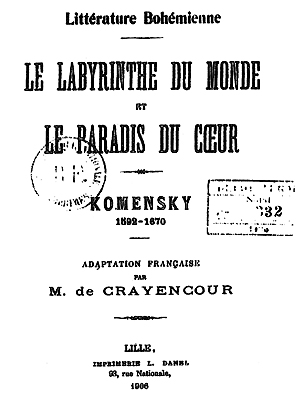 17) Indeed, Michel de Crayencour translated a work from Czech into French of the important philosopher, theologian and pedagogue Johannes Amos Comenius (1592-1670). However, why is there not a single copy in the Vietinghoff’s estate if he really printed 500 books and sent half of them to Jeanne? It is hard to believe Jeanne would have sold some 250 books or that they simply disappeared, especially considering that some of Michel’s and Marguerite’s photographs were kept in addition to documents regarding marriage and house purchases. Thus, the situation concerning the 250 books seems to be another fabrication of M. Y. particularly because the continuation of the story is completely unfounded: Conrad alias “Egon von Reval” allegedly used this book of Comenius The Paradise of the Heart as model for an atonal composition.
In addition, in her comments on her own books, M. Y. is not reluctant to join well-known writers, also by following or taking over titles as she did with her first work from 1927/1928: <9>Alexis ou le Traité du vain combat (Alexis, or the Treatise on the Futile Struggle). This is an obvious parallel to André Gide's La Tentative amoureuse, ou Le Traité du vain désir (The Attempt at Love, or The Treatise on Futile Desire) from 1893 (see also paragraph 35, here below). Similarly, the appropriate title of her trilogy The Labyrinth of the World is not her creation but falls back upon the work of Comenius The Labyrinth of the World and the Paradise of the Heart from 1623 (1631) which is of topical interest.
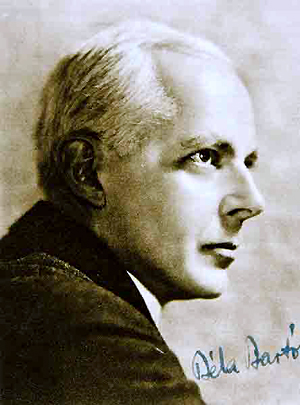 18) (p.166,167) Conrad von Vietinghoff never travelled to Spain to collect old Iberian music and songs. This corresponds rather to Yourcenar’s own activities collecting and translating Negro spirituals and North American Indian fairy tales.
 This embellishment may be borrowed from Béla Bartók’s life (1881-1945) who was a contemporary of Conrad, a world-wide known composer and pianist. He was an innovator of music but did not follow the twelve-tone music as Conrad did neither. Bartok’s single opera and one of his two ballets were rejected by the public because of their offensive passages. In addition to his work as a composer, he recorded folk songs mainly in East Europe and in Turkey.
19) (p.167) M.Y. contradicted herself when she wrote in the mentioned letter (see above paragraph 3) Conrad's homeland was Courland but in this text she narrated his upbringing was on the property of his parents in Estonia. The region of his actual upbringing, Livonia, was either ignored or consciously avoided. Since most of Conrad’s (alias "Egon von Reval") life and character is fiction, it does not matter for his biography, just as the anecdote of Jeanne’s broken ankle accident. Following Yourcenar's chronology we arrive at least the year 1905, i.e. after Jeanne's two boys' birth. The real family residence Salisburg was burned in January 1906 by a revolutionary crowd and remained a ruin until 1932, when it was remodeled as a school. Therefore, her move (after her accident) from the depressing luxury of the mansion to the rustic house of an administrator is doubtful. Also this episode is almost certainly the author's literary invention for the sake of the novel's drama rather than for historical accuracy.
20) (p.170/171) Once in Saint Petersburg, in an early morning, this Egon [von Reval], drunk as a sailor, was taken to his home by his younger brother, who dragged him up the stairs, undressed him and laid him on a bed – he was just a wreck without any human dignity. … Repeatedly, he came back to her not completely drunk but stimulated and with unnaturally shiny eyes, his mouth full of foolish words … vain remarks about …; this silly prattle while he stumbled over the words just as on the stairs until sleep cured this imbecility. "All men in my family drink; when with them I cannot do anything else", he said the next morning.
This is not just a dramatic exaggeration but plain fiction. In all Conrad's family, alcoholism is only known of in one of his nephews between the two world wars, i.e. 10-30 years after this novel's scene. The story brings to mind Yourcenar's friend Jerry who accompanied her from 1980-1986 when she wrote the "autobiographic" novel Quoi? L'Eternité. Furthermore, Yourcenar fabricated a fit of rage when "Egon von Reval" returned to them, his first reaction was to break a vase of clay … and then after a swig of vodka slumped down crying.
(p.187) Jerry was the model for another figure in the novel, "Franz", from whom she created a special friend for "Egon von Reval". After a raid in Rome, both were arrested and Jerry was accused of possession and the dealing of drugs. All these episodes cannot only be as she described emphasizing personal characteristics based on an equality of soul essence in their characters. Nevertheless, these incidences can be considered "autobiographic" inasmuch as the aging author assimilated experiences from her own experiences with friends.
21. (S.149, p.171) His hosts … worried to see them leaving in a cabriolet which Egon [von Reval] recently purchased. Conrad never had a car and never drove. Consequently, the description of "Egon von Reval" as a speeding, weaving, ambulance driver collecting serious casualties during WW I in France does not correspond to the historic Conrad von Vietinghoff at all. Similarly, Jeanne did not work in a private outpatient clinic in Senlis at that time. Anyway, there are three places with this name and all are in Northern France while Jeanne and Conrad lived in Geneva.
22) M.Y. mentioned a male friend of Conrad about whom his sons allegedly were enthusiastic. However, even though the painter Egon von Vietinghoff, the son of Conrad, liked to narrate anecdotes, he never gave any hint of this situation.
This is not just a dramatic exaggeration but plain fiction. In all Conrad's family, alcoholism is only known of in one of his nephews between the two world wars, i.e. 10-30 years after this novel's scene. The story brings to mind Yourcenar's friend Jerry who accompanied her from 1980-1986 when she wrote the "autobiographic" novel Quoi? L'Eternité. Furthermore, Yourcenar fabricated a fit of rage when "Egon von Reval" returned to them, his first reaction was to break a vase of clay … and then after a swig of vodka slumped down crying.
(p.187) Jerry was the model for another figure in the novel, "Franz", from whom she created a special friend for "Egon von Reval". After a raid in Rome, both were arrested and Jerry was accused of possession and the dealing of drugs. All these episodes cannot only be as she described emphasizing personal characteristics based on an equality of soul essence in their characters. Nevertheless, these incidences can be considered "autobiographic" inasmuch as the aging author assimilated experiences from her own experiences with friends.
21. (S.149, p.171) His hosts … worried to see them leaving in a cabriolet which Egon [von Reval] recently purchased. Conrad never had a car and never drove. Consequently, the description of "Egon von Reval" as a speeding, weaving, ambulance driver collecting serious casualties during WW I in France does not correspond to the historic Conrad von Vietinghoff at all. Similarly, Jeanne did not work in a private outpatient clinic in Senlis at that time. Anyway, there are three places with this name and all are in Northern France while Jeanne and Conrad lived in Geneva.
22) M.Y. mentioned a male friend of Conrad about whom his sons allegedly were enthusiastic. However, even though the painter Egon von Vietinghoff, the son of Conrad, liked to narrate anecdotes, he never gave any hint of this situation.
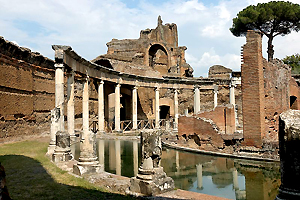 23) It is possible but not certain that Jeanne and Conrad visited the Villa Adriana because in the Vietinghoff's estate there is no photograph from there while there is from many other places in Italy, France, Austria, and Switzerland. On the other hand, M.Y. already knew that place very well before she composed her brilliant novel Hadrian's Memoirs where she had to follow the traces of the emperor Hadrian, the creator of this impressive architectural complex called Villa Adriana, the largest and most lavish palace with park ever built by a Roman emperor.
"Jeanne von Reval’s" hallucination of seeing Michel roaming the park matches for the importance and in those days enchantment of this scenery (later it became a tourist attraction and still is). However, Yourcenar's affirmation I was told this story … from a former friend of Jeanne … is not really convincing considering similar assertions which were woven as stylistic devices into other scenes (see the introduction).
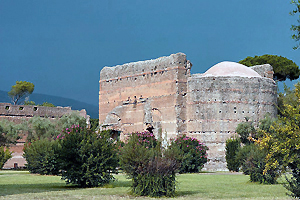 At least she immediately qualified her statement: Everything which is a play of mirrors between people and moments of time, angles of refractions and angles of incidence between imagination and facts is so obscure, so flowing, so impossible to consider from all sides and to define with words that only to mention them is a risk to appear grotesque. Let us speak about coincidence; this term is enough for a lack of further explanation. This is Yourcenar's commentary on Jeanne's fictitious hallucination in the park of the Villa Adriana, however the first half of her thoughts are very consistent with her entire literary work.
24) (p.198) The fictitious "Egon von Reval" has deviated from historical Conrad beyond recognition. Does Michel in this novel also take liberties on the first image of her father or did she really see her father this way? She [the fictitious Jeanne von Reval] heard [Michel] utter insults to Egon von Reval and herself in a low voice and with obscene language, spitting out vulgar abuses which basically did not correspond to the facts nor to the hypocritical euphemisms. … She did not hold out her hand to shake it nor for a hand-kiss. Both persons, who thought they were so closely joined together, have nothing to tell each other anymore. Even during this fictitious scene, the author made no allusion to a common child who should be at the age of three according to Yourcenar’s chronology (see the Michèle Goslar's "hypothesis", paragraph 4).
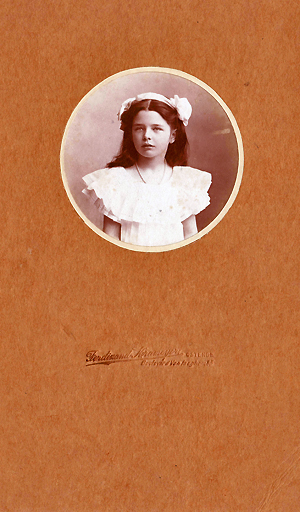 25) (p.232) The Vietinghoffs moved from Paris to Wiesbaden in 1907, from there to Geneva in 1914 and finally to Zurich in 1916 (but not before) but what is distorted in this novel is the move from Paris which takes place in 1913 or later. There is a vague confirmation of the time during WW I (when it was written) (p.298): Michel is walking thoughtfully along the rue Cernuschi [in Paris] but the new faces which he notices at the windows of the third floor give him the confirmation. (Earlier M.Y. said the apartment was in the second floor, p.122). He goes back facing the doorman who says 'The ladies and gentlemen already moved more than two years ago allegedly they stay in German-speaking Switzerland. This mistrustful doorman seems to confuse Switzerland with Germany. If this occurred as written, the doorman would be correct because at that time they were already in Switzerland. Later the writer contradicts herself when she is telling us (p.309) the Vietinghoffs moved from Paris directly to Morges on Lake Geneva but in reality they moved from Wiesbaden to Geneva (p.310) Morges is another of Yourcenar's allusions as it is only situated some 12 km distance from Jouxtens-Mézery where Jeanne was later buried). Therefore the later visits of little Marguerite and her father to the apartment in the rue Cernuschi from 1907 till 1913 belong to the realm of her imagination to fill in the lapses in her memory. She describes these visits with the words (p.232): … afternoon snacks at Jeanne's together with Clément and Axel [Egon und Alexis de Vietinghoff] followed by playing Mikado …, a pick-up sticks game which was indeed often played with the children.
Yourcenar's chronology is vague or even contradictory in the other episode's description (p 254): Jeanne was here. After a visit to her mother in The Hague … she made a stopover in Brussels to say hello to my aunt … She held out her arms to me. I joyously threw myself into her arms. Her kiss simultaneously came from her soul, her heart and all her body that immediately recalled the previous intimacy to me although these last four years of absence meant, at my age, almost half of my life.
Following her chronology, this scene must have occurred not later than 1913. Then Marguerite would be 10 years old and almost half of my life could indeed mean 4 years. However, such a long absence conflicts with her visits to Jeanne's home in the Rue Cernuschi which she dated, after the fictitious scandal in Rome, to the period from 1909 till about 1912. This does not allow an absence of four years and this anyway is not possible due to the move of the Vietinghoff family to Wiesbaden in 1907.
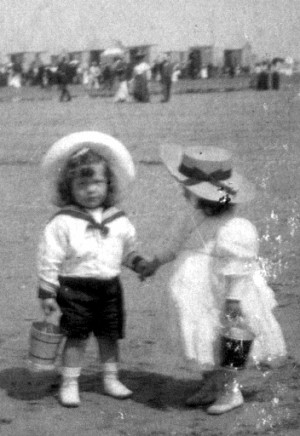
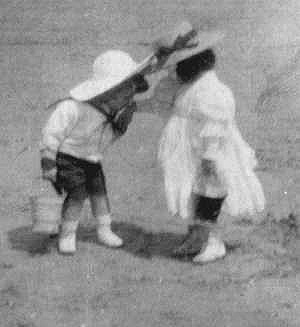 26. (p.126,127) The well-known photographs with the two tots on the beach of Scheveningen where Egon kissed Marguerite's hand, verify that they spent the summer 1905 together as described in the novel. However, Yourcenar depicts the scene with Egon's younger brother but there does not exist any picture that includes Alexis (who is named "Axel" in the novel). Hard to believe that none of those present would have taken a picture of him in Jeanne's arms. Perhaps his grandmother took care of the child in her house in the city since he was less than a year old?
Nevertheless, M.Y. comments about the time when she was 10 years old (i.e. 1913) as following: Clément and Axel were not little children anymore ('Look how polite I already was at that time" says Clément and shows me the pictures from the past, "I kissed your hand already", as I was not a little girl anymore. By writing this, she disregarded time and distance because in 1913 she lived in Paris but Egon in Wiesbaden, and the hand-kiss photograph was obviously taken when they were two (i.e. 1905).
 29) It is correct that Conrad von Vietinghoff occasionally helped at the Red Cross in Geneva during WW I. He was good hearted, spoke several languages, and had time. According to his son Egon, he sorted mails for German prisoners of war and forwarded letters to them. Allegedly because of the hatred of the Germans there was hardly someone willing to do this job. In this atmosphere, a neighbor caused the police to investigate Conrad on suspicion of spying. But he was such a pacifist, naïve and a somewhat clueless musician! The process was painfully annoying and completely absurd. A distant relative, a German-Baltic and officially a Russian subject as well, was involved in this story. After a certain period, the legal proceedings were abandoned. The internationally known writer and pacifist Romain Rolland, four years older than Conrad, had the same job at the Red Cross in Geneva; he was awarded the Nobel Prize for Literature in 1915.
 By doing so, it is possible that Conrad also found names of acquaintances or relatives. However, it is not evident that he deliberately searched for a lover in the office of the Red Cross (see Michèle Goslar, Cidmy Bulletin 18, p.21) neither that Jeanne found the name of "Franz" from Yourcenar’s novel Quoi? L’Eternité on a Red Cross list and the Vietinghoff couple tried to get news concerning him. Anyway, the entire "anecdote" of "Franz" seems to originate from Marguerite Yourcenar's fiction.